

SIPRI Yearbook 2026 highlights on nuclear arms, indicated that the global nuclear order is deteriorating, modernisation is accelerating, and the USA-Russia stockpile remains overwhelmingly dominant even as China expands fastest.
New satellite imagery indicates China is constructing launch pads near recently built missile silos—enhancing readiness and survivability of its land-based nuclear force reported by many news agencies. Simultaneously, the expiry of the last remaining US-Russia strategic arms control treaty (New START) on 05 February 2026, marks the transition toward an era of unconstrained nuclear competition. The emerging triangular nuclear dynamic among the United States, Russia and China is reshaping global security architecture and validating concerns raised years ago regarding China’s nuclear ambitions.This rapid expansion reshapes deterrence dynamics, complicates U.S.-Russia treaty frameworks, and reinforces the Cold War 2.0 trajectory I assessed earlier. The arms control architecture cannot be renewed on a bilateral basis if a third major nuclear power remains outside binding limits.
This post integrates the latest open-source reporting on new Chinese launch pads near missile silo fields with my prior assessment that Beijing’s nuclear acceleration is a defining driver of Cold War 2.0–style competition, published in Modern Diplomacy (EU)(The link is attached and the text reproduced to enable readers who don’t have subscription to it. It explains why China’s opaque buildup is a central factor in the non-renewal and effective lapse of U.S.–Russia strategic arms control, and it outlines strategic options for India and like-minded partners.
https://moderndiplomacy.eu/2023/06/19/chinese-nuclear-push-in-cold-war-2-0-makes-world-unsafe
China’s Nuclear Expansion and the End of Strategic Arms Control: Entering a More Dangerous Cold War 2.0
By Major General Dr S.B. Asthana
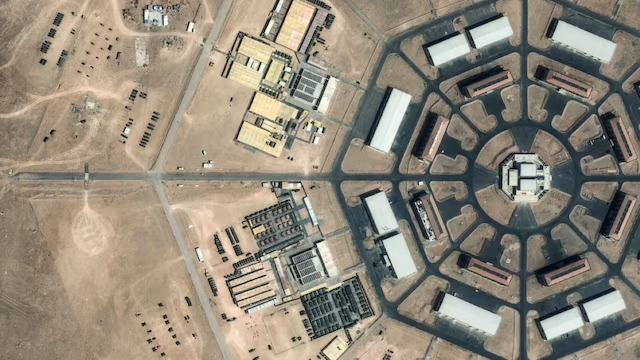
Recent satellite imagery revealing extensive Chinese construction of launch pads, support facilities, communications hubs and military infrastructure near its nuclear missile silo complexes has once again brought the issue of strategic stability into sharp focus. Analysts studying the imagery have identified more than eighty launch-related facilities and associated military infrastructure linked to China’s expanding strategic missile force. The developments are concentrated around the Hami missile fields and adjoining regions in Xinjiang and Gansu.
For seasoned strategic observers, these developments are not surprising. They represent a continuation of a trajectory that has been visible for years. In June 2023, I had argued in my article, “Chinese Nuclear Push in Cold War 2.0 Makes World Unsafe,” that Beijing’s nuclear modernization was moving beyond the traditional doctrine of minimum deterrence and was increasingly becoming a central pillar of China’s great-power ambitions. Today, unfolding events appear to validate those concerns.

Photo Credit Vanter via Reuters, NBC News
The Strategic Meaning Behind the New Construction
The latest satellite imagery indicates that China is not merely increasing the number of nuclear warheads. It is investing in survivability, mobility, redundancy and resilience of its strategic deterrent.
The infrastructure reportedly includes launch pads, hardened facilities, communications networks, electronic warfare support systems and logistics nodes. Security analysts assess that these facilities could support road-mobile intercontinental ballistic missiles, advanced command-and-control structures and enhanced second-strike capabilities.
From a military perspective, the significance is profound.
The objective appears to be ensuring that even after absorbing a devastating first strike, China would retain sufficient nuclear capability to impose unacceptable costs on an adversary. Such survivability lies at the heart of credible deterrence.
China is therefore attempting to move from a relatively limited deterrence posture toward a more robust and flexible nuclear architecture capable of operating in a highly contested strategic environment.
Why China Has Become the Missing Piece in Arms Control
The global strategic landscape has fundamentally changed from the bipolar Cold War environment that shaped earlier arms control agreements.
For decades, nuclear arms control primarily revolved around Washington and Moscow because they possessed the overwhelming majority of the world’s nuclear weapons. Treaties such as START, New START and their predecessors were designed around that bilateral reality.
That reality no longer exists.
China’s nuclear arsenal is expanding faster than that of any other major power. Various strategic assessments indicate that Beijing could possess approximately 1,000 nuclear warheads by 2030 if current trends continue. Its growing missile infrastructure, advanced delivery systems and improving early-warning architecture suggest that Beijing seeks a far larger role in the global nuclear balance.
Consequently, both Washington and Moscow have increasingly argued that future arms control frameworks cannot remain exclusively bilateral.
The central dilemma is straightforward: neither the United States nor Russia wishes to remain constrained by treaty limitations while a third major nuclear competitor continues expanding without comparable restrictions.
The Expiry of New START and the Beginning of a New Era
The New Strategic Arms Reduction Treaty (New START), signed in 2010 and extended in 2021, expired in February 2026 after becoming the final surviving pillar of US-Russia strategic arms control. The treaty had limited deployed strategic nuclear warheads and delivery systems while providing transparency and verification mechanisms.
Its expiration marks far more than a legal milestone.
It symbolises the collapse of the arms control architecture that helped regulate nuclear competition between the world’s two largest nuclear powers for decades.
Washington has consistently maintained that future strategic arrangements must address China’s expanding arsenal. Russia has similarly highlighted the growing relevance of third-country nuclear forces in future negotiations. Yet Beijing has remained reluctant to enter formal trilateral arms control arrangements, arguing that its arsenal remains significantly smaller than those of the United States and Russia.
The result is strategic deadlock.
Without a framework acceptable to all three powers, the prospects for meaningful arms control have steadily diminished.
The Emergence of a Trilateral Nuclear Competition
The world is increasingly witnessing the evolution of a triangular nuclear balance involving the United States, Russia and China.
Unlike the relatively predictable bipolar deterrence model of the Cold War, triangular deterrence is inherently more complex.
Each power must simultaneously calculate the capabilities, intentions and potential actions of two other nuclear competitors.
Particularly concerning is the Indo-Pacific theatre, where growing tensions surrounding Taiwan, the South China Sea and broader US-China rivalry continue to intensify. Recent strategic assessments have warned that any major conflict involving Taiwan carries significant risks of nuclear escalation.
Implications for India and the Indo-Pacific
For India, China’s nuclear expansion has direct strategic implications.
India’s security calculations are uniquely complicated by the reality of a two-front challenge involving China and Pakistan, whose strategic relationship continues to deepen.
As China’s strategic capabilities expand, India’s deterrence posture, missile defence planning, maritime strategy and technological modernisation will require continual reassessment.
Simultaneously, the Indo-Pacific security architecture is undergoing significant transformation. The QUAD, AUKUS and various regional security arrangements are evolving partly in response to concerns regarding China’s growing military power.
The challenge for policymakers lies in maintaining credible deterrence while avoiding an uncontrolled escalation of regional arms competition.
The detailed Analysis published in many media platforms is reproduced below:-
Chinese Nuclear Push in Cold War 2.0 Makes World Unsafe as Global Focus Continues on US-Russian Contestation
Backdrop
With the over-involvement of USA to weaken Russia in continued Cold War 1.0, unrestrained China is making rapid strides in enhancing its Comprehensive National Power including nuclear power using Russian resources and technology, due to latter’s increased dependence on it. In May 2023, Russia agreed to supply highly enriched uranium-235 to energy-hungry China over the next three years. The final product could be plutonium 239, that is primarily used in nuclear warheads, which can support President Xi Jinping’s pledge at last October’s 20th Communist Party congress to “strengthen strategic deterrence” as its military tensions with the United States and its allies rise, to expand its nuclear arsenal. On the Chinese eastern sea board, 135 miles from Taiwan, China is preparing to start a fast breeder nuclear reactor, designed to make Plutonium, which the Pentagon views as fuel generation facility for its vast expansion of nuclear arsenal.
How Chinese Grand Strategy Propagates Nuclear Expansionism?
The Peoples Republic of China’s (PRC) strategy aims to achieve “the great rejuvenation of the Chinese nation” by 2049 to match USA’s global influence and power, eventually displace it, its alliances and security partnerships in the Indo-Pacific region. The aim being to build a China centric Asia initially, and later a China dominated international order to suit CCP’s authoritarian system and Chinese national interests. This strategy demands multi-dimensional expansion of Chinese national power including its nuclear power.
China’s nuclear doctrine has gradually experienced the process change from a ‘Counter-nuclear Blackmail Strategy’ to a ‘Minimum Deterrence Strategy’ and now seems to be graduating to ‘Limited Nuclear Deterrence’. China’s counter-nuclear blackmail doctrine included the fact that finally winning a war will require conventional weapons, however Beijing feels that the relevance of its nuclear weapons’ is to deter the enemy from launching an initial nuclear attack against China.
Towards this aim China aims to expand, modernise, and diversify its nuclear forces, having established a “nuclear triad” already. It is estimated that China has produced a stockpile of approximately 410 nuclear warheads for delivery by land-based ballistic missiles, sea-based ballistic missiles, and bombers. Additional warheads are thought to be in production to eventually arm additional road-mobile and silo-based missiles and bombers. The Pentagon’s 2021 report to Congress estimated that by 2030 China’s nuclear stockpile “will have about 1,000 operational nuclear warheads, which SIPRI 2026 indicates that 620 warheads holding has already been achieved by 2025, most of which will be fielded on systems capable of ranging the continental United States” If expansion continues at the current rate, the Pentagon projected, China might field a stockpile of about 1,500 nuclear warheads by 2035. SIPRI Report 2026 indicated that China in early 2026 had deployed 34 nuclear weapons.
These targets along with Chinese hunger for more nuclear energy, initially looked to be difficult due to the bottleneck of scarcity of uranium, but with Russian assurance of supplies of 30 percent concentrated uranium-235, makes it achievable, with estimated capacity of adding 50 nukes per year to its stockpile. With the continuous increase of China’s nuclear power plant capacity, it is estimated that by 2030, China will replace the US to become the world’s number one uranium buyer, with the gap between uranium demand and domestic supply being bridged with Russian help.

Chinese Nuclear Modernisation Trajectory
China reorganised its Strategic Rocket Forces, (PLARF, previously called the Second Artillery) with modern C4ISR capabilities as well as logistics capabilities to facilitate its mobility, maintenance and storage capabilities. The successful test of a hypersonic glide vehicle in 2021 demonstrated enhanced global reach of China’s strike capabilities.
In last few years, China has continued to modernize its road-mobile and rail mobile DF-31 and DF-41 (intercontinental ballistic missile (ICBM) with ranges from 7000 to 15,000 kilometres), has significantly advanced the construction of its three new missile silo fields for solid-fuel ICBMs, and has also expanded the construction of new silos for its liquid-fuel DF-5 ICBMs and its variants with ranges up to 13000 kilometres. China is also significantly expanding its DF-26 intermediate-range ballistic missile force and has also begun replacing some older conventional short-range ballistic missiles with new DF-17 medium-range ballistic missiles equipped with hypersonic glide vehicles. The DF-41 can carry multiple independently targetable re-entry vehicles (MIRV).
In maritime domain, China apparently has refitted its six Type-094 ballistic missile submarines with the longer-range JL-3 submarine-launched ballistic missile. Reportedly, a larger Type 096 is in development, which can enhance range from 7,200 kilometres to 9,000 kilometres. The PRC is also developing Type 096 SSBNs with the ability to launch SLBMs with multiple independent re-entry vehicles (MIRVs).
The mainstay of PLAAF component of the nuclear triad through the H-6N bomber. The bomber has an air-to-air refuelling mechanism to extend its range of 1,800 km. In addition, China has recently reassigned a nuclear mission to its new strategic bombers and is developing an air-launched ballistic missile with nuclear capability. This includes the development of the nuclear-capable subsonic strategic stealth bomber, the Xian H-20, which could enter service as early as 2025, comparable to the U.S. B-2 bomber.
New developments suggest that China intends to increase the peacetime readiness of its nuclear forces by moving on to a ‘launch-on-warning’ (LOW) posture with an expanded silo-based force, from ‘launch on attack’ mode. With 120 silos under construction at Yumen, another 110 silos at Hami, a dozen silos at Jilantai, and possibly more silos being added in existing DF-5 deployment areas, PLARF appears to have approximately 250 silos under construction – more than ten times the number of 20 ICBM silos in operation today. It is believed that more than 14 sites are associated with Nuclear weapon programmes.
How Chinese Nuclear Strategy Puts Global Disarmament in Reverse Gear?
China’s stated Nuclear Doctrine is no different from most of the nuclear powers and it will like the world to believe that its totally benign. Itis composed of five policies: policy of declaration, nuclear development, nuclear deployment, nuclear employment, and nuclear disarmament. Its stated characteristics include no-first use of nuclear weapons, building of a lean and effective strategic nuclear force, maintain a second strike capability, nuclear employment is self-defence/retaliation. It maintains that its policy on nuclear disarmament regards the complete prohibition and thorough destruction of nuclear weapons.
Chinese Ambassador in UN on 11 October, 2022, accusing West (indirectly US) of Cold War mentality, obsessed with the “major power strategic competition” continuously instigating competition and confrontation among major countries in Eurasia and Asia-Pacific and stirring up bloc confrontation. He tabled China centric proposals of Global Security Initiative, to maintain global strategic stability. He put the onus of disarmament on US & Russia (who have maximum nukes) to start disarmament, for other nuclear states to follow. thereby justifying its expansion plan. China accused others for failed 10th NPT Review Conference, not arriving at a consensus, outsmarting accusation against itself of violating it. It made a case for Iran urging US to implement JCPOA, citing AUKUS as proliferation of NPT, cornering US to stop regional and global deployment/mechanisms/extension of nuclear umbrella, especially in Asia-Pacific.
China has been projecting itself to be firmly upholding multilateral international order and its active support to the international disarmament process. China puts the onus of it not ratifying CTBT, on US not doing so and India and Pakistan not even signing it. China also takes an active part in the work of the UN Group of Governmental Experts on Nuclear Disarmament Verification and early commencement of negotiation on a fissile material cut-off treaty within the (Conference on Disarmament) in accordance with the Shannon Report (CD/1299) to negotiate a treaty banning the production of fissile material for nuclear weapons or other nuclear explosive devices. Chinese strategic aim in this case is to promote dialogue between P5 and ASEAN countries on the issue of signing the Protocol to the Treaty on the Southeast Asia Nuclear-Weapon-Free Zone, to avoid a potential nuclear deployment from US in its South Eastern neighbourhood. China doesn’t pay heed to US demand of entering into INF Reduction talks, has smartly remained out of START treaty citing limited capability, putting entire disarmament process in reverse gear, which is already suspended by Russia as a side-effect of Russia Ukraine War.
How Does Chinese Nuclear Strategy Impacts India?
From Indian perspective, the rapid expansion of Chinese nuclear and missiles arsenal, deployment of several versions DF-21 in Tibet, Xinjiang and elsewhere, along with its alleged proliferation to Pakistan, poses a serious collusive challenge. India is the only country in the world having two nuclear armed belligerent neighbours with unsettled border in collusive arrangement, thereby posing a potential ‘two-front threat under nuclear overhang’ although China and India have shown maturity by refraining themselves from any nuclear reference during three years of Ladakh standoff. Clearly Chinese nuclear ambition is USA centric, benchmarked for competition with USA, which can cater for any lesser adversary.
China along with other nuclear powers, imposed sanctions on India through 1172 resolution in the UN Security Council. While others have recognised India as a “State with nuclear weapons” and are supporting India for a clean waiver” at the Nuclear Suppliers Group (NSG) after the ‘123 agreement’ in 2008, China continues to block in India’s entry into the NSG, and quest for clean energy, although India is somehow managing it bilaterally.
China explicitly undertakes not to be the first to use nuclear weapons at any time and under any circumstances, and unconditionally commits itself not to use or threaten to use nuclear weapons against non-nuclear-weapon States or nuclear-weapon-free-zones. India doesn’t qualify in any of the two categories; hence nukes can be used against India if strategic situation demands so, but the restraining factor is that India too has ensured credible minimum deterrence, with a nuclear triad, and Agni 6 in pipeline.
The Chinese nuclear expansion of nuclear warheads, advanced delivery systems, can certainly accelerate nuclear arms race in the South Asian region increasing complication of fusion of conventional and nuclear systems using same delivery system.
Should India Revisit Its Nuclear Doctrine or Modernisation Plans?
In May 2023, India celebrated its 25th Anniversary of Shakti tests to become a Nuclear Weapon State, and it must needs to do capacity building in all domains of warfare including nuclear dimensions in terms of strategic assets, delivery, control, communication and maintenance systems, with induction of state of the art technology.
India’s nuclear doctrine of maintaining a posture of “No First Use” nuclear weapons, will only be used in retaliation against a nuclear attack on Indian territory or on Indian forces anywhere has served Indian strategic interest well so far. The current policy caters for nuclear retaliation to a first strike to be massive and designed to inflict unacceptable damage to adversary. It also lays down that in the event of a major attack against India, or Indian forces anywhere, by biological or chemical weapons, India will retain the option of retaliating with nuclear weapons. As per SIPRI Report 2026, India increased its nuclear arsenal to 190 in the begining of 2026, with 12 warheads on peacetime deployment.
China symbolically hasn’t changed its No First Use policy on paper, although on ground there are indications that it is planning to use nuclear weapons not only to deter the adversaries, but also be able to counter-attack if deterrence fails, to protect its national security. China is also known to have violated its signed policies at opportune moment, as seen in case of UNCLOS in South China Sea and CBMs in case of LAC in Himalayas; hence, its statements are not worth relying. India certainly needs to re-evaluate its strategies at appropriate levels and in case any changes are required it should be undertaken, wherever our national interest demands so.
India is a nuclear country with effective nuclear triad, maintaining the nuclear arsenal just to meet the requirement of minimum credible nuclear deterrence. India has an option of retaliatory nuclear strike in case of a nuclear attack and has delivery systems to reach Chinese heartland with Agni5 and will have capability to reach anywhere with Agni 6 under development. India has its own air defence and missile defence umbrella and should constantly look to upgrade its capabilities.
The nuclear arms control will be driven by Big Power Contestation and is a global issue, which might not get resolved in Asia. China doesn’t recognise India as a nuclear state and any Strategic Arms Control talks or initiatives between the two are unlikely. Chinese are comparing themselves with US and Russia and all these powers have to be on board for any possibility of disarmament initiatives. We also have some rogue states like Pakistan, who attribute their survival to nuclear bomb. Indian policy supports disarmament and nuclear arms control in non-discriminatory manner and shall continue to do so, but currently there are not many takers. Conversely more countries in Asia are wanting to go nuclear like Iran or may be Japan or South Korea in future, should their adversaries continue with crude threat of nukes! Possibilities of nuclear arms control don’t look positive in near term in Cold War 2.0 scenario.
Major General (Dr) S B Asthana
(The views expressed are personal views of the author, who retains the copy right). The author can be reached at Facebook and LinkedIn as Shashi Asthana, @asthana_shashi on twitter, and personnel site https://asthanawrites.org/ email shashiasthana29@gmail.com LinkedIn Profile www.linkedin.com/in/shashi-asthana-4b3801a6
To watch such analysis consider subscribing https://www.youtube.com/@GenAsthanaAnalyses
Discover more from Asthana Writes
Subscribe to get the latest posts sent to your email.


