
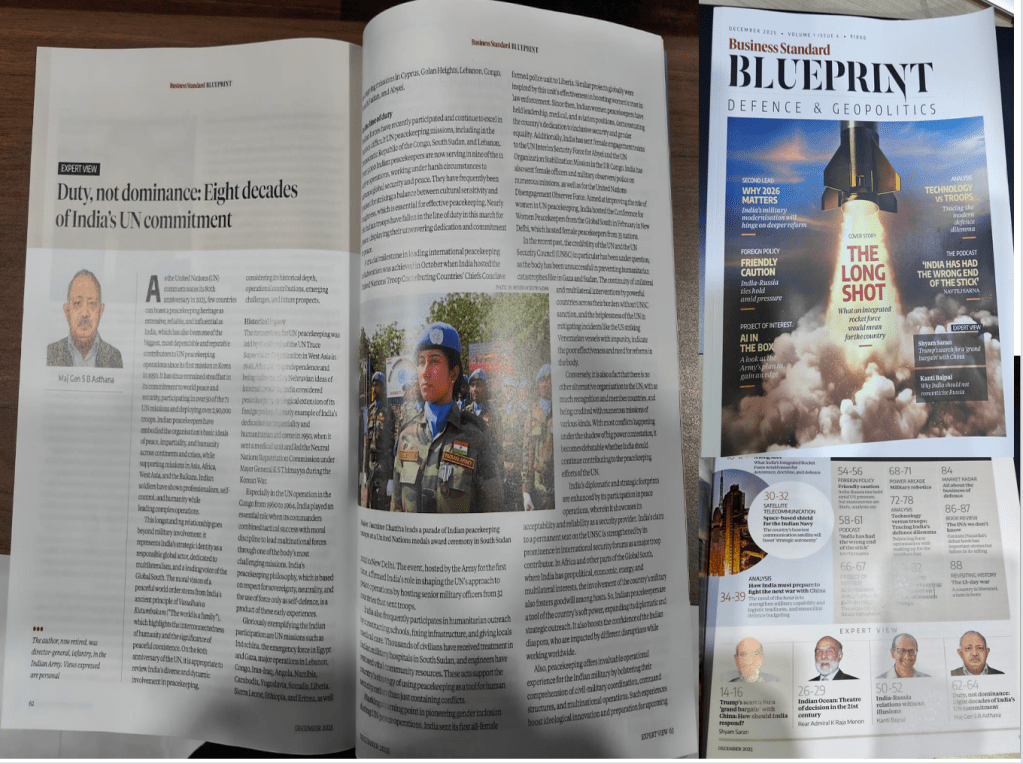
Sharing an analysis of mine on the topic published in Journal Blueprint, Business Standard, Print Edition, December 2025, Volume 1, Issue 4, December Edition, titled “Duty Not Dominance: Eight decades of India’s UN Commitment”. I am reproducing the article to enable readers to access the contents if they don’t have the subscription for Premium content.
“India views peace operations as a duty rather than dominance, and its approach to UN peacekeeping combines morality and modernity. India aims to humanise global security by supporting women’s empowerment, technological ethics, reforms, and leadership from the Global South. India’s model demonstrates that the real tools of peace are capability, empathy, and credibility as the world’s conflicts get more complicated”
The article examines India’s long-standing role and evolving stakes in UN peacekeeping, highlighting its status as one of the largest troop contributors and a strong political advocate of multilateralism. It traces India’s participation from early missions to complex contemporary operations, underlining operational successes, sacrifices, and reputational gains. The piece also critiques challenges—ranging from mandate dilution and inadequate resources to politicisation of peace operations and limited decision‑making influence despite high contributions. It argues that India must leverage its peacekeeping record to press for greater voice in UN structures while adapting capabilities to new, multidimensional conflict environments. It also advocates revisiting policies of troop contribution and a thorough cost benefit analysis from the prism of national interest, before committing troops.
India and UN Peacekeeping: Eight Decades of Commitment, Courage, and Credibility
Major General Dr S. B. Asthana,SM,VSM,PhD (Veteran)
Backdrop: Eighty Years of the UN and India’s Enduring Partnership
Few countries can boast a peacekeeping heritage as extensive, reliable, and influential as India’s as the UN commemorates its 80th anniversary in 2025. India has been one of the biggest, most dependable, and most reputable contributors to UN peacekeeping operations (UNPKOs) since it made its first contribution in Korea in 1948. Since then, it has remained steadfast in its commitment to world peace and security, taking part in over 50 of the 71 UN missions and deploying over 290,000 troops. Indian peacekeepers have embodied the UN’s basic ideals of peace, impartiality, and humanity across continents and crises, supporting missions in Asia, Africa, the Middle East, and the Balkans (United Nations Peacekeeping, 2024). Indian soldiers have shown professionalism, self-control, and humanitarian care while leading complicated operations.
This long-standing relationship goes beyond military involvement; it represents India’s strategic identity as a responsible global actor, dedicated to multilateralism, and a leading voice of the Global South. The moral vision of a peaceful world order stems from India’s ancient principle of “Vasudhaiva Kutumbakam” (whole world is my family), which highlights the interconnectedness of humanity and the significance of peaceful coexistence. It is appropriate to review and reevaluate India’s diverse involvement in peacekeeping on the 80th anniversary of the UN, taking into account its historical depth, operational contributions, emerging challenges, and future prospects.
Historical Legacy of Indian Participation in UN Peacekeeping
The United Nations Truce Supervision Organisation (UNTSO) was established in the Middle East in 1948, marking the beginning of UN peacekeeping. India considered peacekeeping as a logical extension of its foreign policy activities after gaining independence and being influenced by Nehruvian ideas of internationalism. An early example of India’s dedication to impartiality and humanitarian aid occurred in 1950, during the Korean War, when it sent a medical unit and led the Neutral Nations Repatriation Commission under Major General K. S. Thimayya.
India played an especially important part in the UN Operation in the Congo (ONUC, 1960–1964). Indian commanders combined tactical success with moral discipline to lead multinational forces through one of the UN’s most challenging missions. India’s peacekeeping philosophy, which is based on respect for sovereignty, neutrality, and the use of force only in self-defence, was formed by these early experiences.
Indochina, the UN Emergency Force in Egypt and Gaza, major missions in Lebanon, Congo, Iran-Iraq, Angola, Namibia, Cambodia, Yugoslavia, Somalia, Liberia, Sierra Leone, Ethiopia, and Eritrea, as well as ongoing missions in Cyprus, Golan Heights, Lebanon, Congo, S Sudan, and Abyei, are just a few examples of the glorious journey of Indian participation.
Recent Engagements: Demonstration of Operational Excellence
Indian forces have recently participated in and continue to excell in a variety of difficult missions, including the Democratic Republic of the Congo (MONUSCO), South Sudan (UNMISS), and Lebanon (UNIFIL) (UN Peacekeeping, 2024). Over 5,000 Indian peacekeepers are now serving in nine of the eleven active missions, working under difficult circumstances to advance global security and peace. Their performance has frequently been praised for striking a balance between cultural sensitivity and toughness, which is essential for effective peacekeeping. Nearly 180 Indian troops have fallen in line of duty in this march for peace, displaying their unwavering dedication and commitment for peace.
Leadership Initiatives: An important milestone in international peacekeeping collaboration was reached in October 2025 when India hosted the United Nations Troop Contributing Countries’ (UNTCC) Chiefs’ Conclave 2025 in New Delhi. The event, which was hosted by the Army for the first time, affirming India’s role in shaping the United Nations’ approach to peace operations by bringing together senior military officers from 32 countries that sent troops.
Humanitarian Engagement: Indian contingents frequently participate in humanitarian outreach, constructing schools, fixing infrastructure, and giving locals medical care. Thousands of civilians have received treatment in Indian military hospitals in South Sudan, and engineers have restored vital community resources. These acts support India’s strategy of using peacekeeping as a tool for human security rather than just containing conflicts.
Pioneering Gender Inclusion: India sent its first all-female Formed Police Unit to Liberia, marking a turning point in UN peace operations. Similar projects around the world were sparked by this unit’s effectiveness in boosting women’s trust in law enforcement. Since then, Indian women peacekeepers have held leadership, medical, and aviation positions, demonstrating the country’s dedication to inclusive security and gender equality. Additionally, India has sent Female Engagement Teams to the United Nations Interim Security Force for Abyei and the United Nations Organisation Stabilisation Mission in the Democratic Republic of the Congo. India has also sent female staff officers and military observers on a number of missions, as well as female military police with the United Nations Disengagement Observer Force. In February, 2025, in New Delhi, India hosted the Conference for Women Peacekeepers from the Global South, which brought together female peacekeepers from 35 Global South nations aimed to improve the role of women in UN peacekeeping.
Why Should India Undertake Peacekeeping Commitments?
In the recent past the credibility of United Nations in General and UNSC in particular has been under question, as it has been unsuccessful in preventing or mitigating many humanitarian catastrophe like Gaza and Sudan. The fact that unilateral and multilateral interventions by powerful countries across their borders without UNSC sanction continue to happen and UN finds itself helpless in preventing incidents like USA striking vessels of Venezuela with impunity, indicates the poor effectiveness and need for reforms in UN. Conversely, It’s also a fact that there is no other alternative organization to UN, with as much recognition and membership of various countries, having large No of missions of various kinds to its credit. With most conflicts happening under the shadow of Big Power Contestation, it becomes a debatable whether India should continue contributing to peacekeeping effort of UN or otherwise?
Strategic and Diplomatic Footprints: Participation in Peace operations enhances India’s diplomatic clout by showcasing its acceptability and reliability as a security provider. India’s claim to a permanent seat on the UN Security Council is strengthened by its prominence in international security forums as a major troop contributor. In Africa and other parts of the Global South, where India has geopolitical, economic, energy, and multilateral interests, the involvement of Indian military also fosters goodwill among host countries. Thus, Indian peacekeepers are a tool of India’s soft power, expanding its diplomatic and strategic outreach. Additionally, it boosts the confidence of the Indian diaspora, who are impacted by all types of disruptions while working in different areas of the world.
Professional Benefits: For the Indian military, peacekeeping offers invaluable operational experience. It improves their comprehension of civil-military coordination, command structures, and multinational operations. Experience like this helps with ideological innovation and preparation for upcoming humanitarian or coalition projects Conversely, if India doesn’t send troops, some of its adversaries can take a lead and send troops in certain areas, which may not be in Indian strategic interest.
Moral and Ideational Ethos: India has been a consistent propagator of peace everywhere in the world. Participating in peace operations demonstrates Indian commitment to peace, moral leadership and international solidarity. This idealism is in sync with India’s multilateral diplomacy.
Is Peacekeeping Cost Effective for India?
India’s Claim for UNSC Permanent Seat: Contributing troops for peace operations has very little impact on Indian claim for permanent seat in UNSC, as it relates to a bigger issue of geopolitical power play between P5 members. A reform in UNSC structure requires a change in UNSC charter for which all P5 members must agree. The veto power enables any one of the P5 member to prevent the adoption of any “substantive” draft Council resolution, regardless of its level of international support. Articles 108 and 109 of the United Nations Charter grant the P5 veto over any amendments to the Charter. It thus becomes obvious that even if one member of P5 doesn’t agree to any reform, the UNSC cannot be reformed, obstructing India’s claim to become permanent member of UNSC.
Operational Constraints: Troops and resources committed for peace operations may not be available at short notice to India, for deployment to meet its own external threats. With multiple fronts emerging in recent past, in view of geopolitical turbulence in Indian neighbourhood, sparing resources for Peacekeeping missions needs to be reviewed through objective cost benefit analysis. Many missions often face logistical and resource constraints and get influenced by regional and global powerplay, which may not be in Indian interest. Delayed reimbursements, unclear mandates, and insufficient technology can affect mission effectiveness impacting Indian reputation. These factors must be evaluated before committing troops.
Security Risks and Sacrifice: The country is proud of its gallant ‘Blue Beret’ heroes as 180 Indian peacekeepers made supreme sacrifice while serving with UN, highest by any country. These sacrifices underlines the risks involved and the need for upgradation of resources, procedures, technology, intelligence sharing, situational awareness, safety mechanisms and legal cover (Chapter VII). However, India needs to revisit its policies to convince itself whether causalities occurring due to firefight between various state and non-state actors in various regions, where India has no national interest, are really worth it or otherwise?
India and the Future of UN Peacekeeping/Peace Operations
India’s Strategic Vision: The “4 Cs“—Consultation, Cooperation, Coordination, and Capacity Building—represent India’s approach for cooperative, fair peace operations, according to Indian Defence Minister Rajnath Singh. In order to give troop-contributing nations (TCCs) a decisive voice in mission planning, India strategically promotes democratisation within the UN. The vision positions India as a reformer rather than merely a responder by fusing operational realism with moral legitimacy.
Adapting to New Conflict Realities: Terrorism, hybrid warfare, and non-state actors are becoming more prevalent in contemporary wars. For these kinds of situations, traditional peacekeeping philosophies are frequently insufficient. As a result, India has promoted “robust peacekeeping,” which incorporates technology-driven solutions, improved ISR capabilities, situational awareness, and peace enforcement.
Towards a New Paradigm: India’s experience puts it in a position to influence UN peace efforts in the future. Instead of focussing only on ceasefire monitoring, it supports mandates that prioritise local ownership, conflict avoidance, and peacebuilding. In context of women empowerment, India aims to increase women’s participation to 15% in the coming years, in line with the UN’s Uniformed Gender Parity Strategy.
Capacity Building and Global South Cooperation: Officers from Asia, Africa, and Latin America are trained at the Centre for United Nations Peacekeeping (CUNPK) in New Delhi, which acts as a regional centre. India’s larger aim of collaboration among the Global South, exchanging operational know-how and boosting international solidarity, is reflected in this effort.
India’s Call for Multilateral Reform: India believes that genuine reforms in UNSC must reflect contemporary realities, where countries like India play pivotal roles in maintaining international peace and security.
Conclusion: Peacekeeping to Peacebuilding
Peacekeeping needs to change into a more flexible, inclusive, and technologically advanced system as the UN approaches its ninth decade, with greater emphasis towards peacebuilding. India’s eight-decade relationship with the UN serves as an example of how moral vision and national capacity can come together for the benefit of the world.
For India, peacekeeping is a reflection of its civilisational ethos—Vasudhaiva Kutumbakam—rather than just a diplomatic tool. India’s skilled, sympathetic, and creative peacekeepers will continue to be essential to maintaining world peace as crises get more complicated. However, future peacekeeping commitments must be viewed with realistic cost benefit analysis in Indian strategic interest.
India views peace operations as a duty rather than dominance, and its approach to UN peacekeeping combines morality and modernity. India aims to humanise global security by supporting women’s empowerment, technological ethics, democratic reforms, and leadership from the Global South. India’s model demonstrates that the real tools of peace are capability, empathy, and credibility as the world’s conflicts get more complicated.
Major General (Dr) S B Asthana
(The views expressed are personal views of the author, who retains the copy right. The author is a Globally acknowledged Strategic and Security Analyst, He can be reached at Facebook and LinkedIn as Shashi Asthana, @asthana_shashi on twitter, and personnel site https://asthanawrites.org/ email shashiasthana29@gmail.com Youtube link https://www.youtube.com/channel/UCl50YRTBrOCVIxDtHfhvQDQ?view_as=subscriber
 Asthana Writes